Wolfgang Autexier
1. Congratulations on winning in the Global Photography Awards! Can you share a little about yourself, what inspired you to pursue photography, and how has your journey evolved since your first shot?
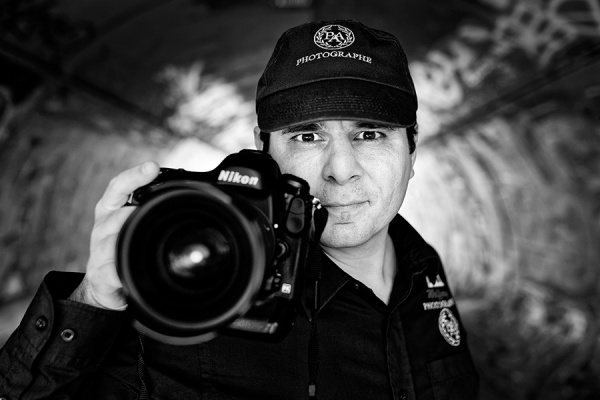
I define myself first as a visual artist and, perhaps, as a poet working through photography. Before photography became central to my practice, I spent many years drawing and painting, especially with pastel and watercolor. That background still shapes the way I see: I do not approach photography merely as a way of recording the visible world, but as a way of interpreting it, composing it, and giving form to what cannot always be said directly. My first encounter with photography came very early. It began with film, with the physical and patient side of the medium, before digital photography opened a more immediate and intuitive field of expression. For many years, wildlife photography was my main practice. It taught me patience, attention, humility and the ability to respond to the unexpected. Over time, my work expanded toward architecture, landscapes, portraiture and the nude. This evolution was not a rejection of my earlier subjects, but a movement toward a more interior form of photography. I became increasingly interested in the relationship between the human body, space, silence, light and spiritual suggestion. Today, with 220 international distinctions, including 60 awards, I feel deeply grateful and infinitely happy to have built the most extensive record of international distinctions achieved by a French photographer in international photography competitions. Yet I do not see this journey as a final destination, but as a responsibility. I hope my work can be inspiring: not only through its achievements, but also through the idea that an artist can patiently build a personal visual language and allow it to travel beyond borders.
2. Can you share the story or inspiration behind your award-winning piece? How does winning this award make you feel about your journey in photography?
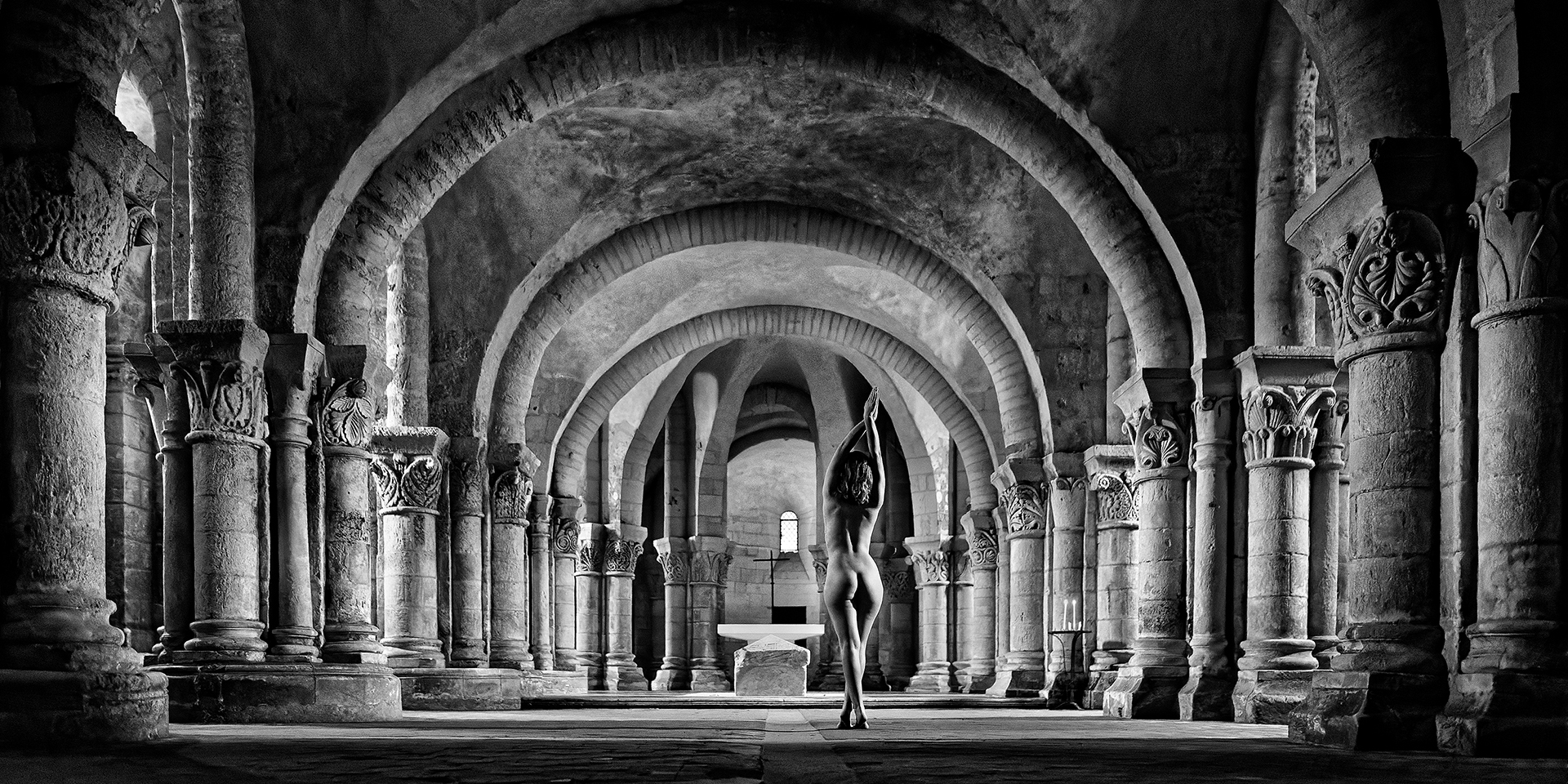
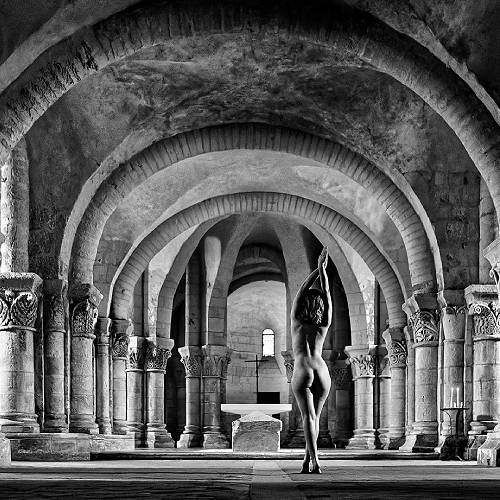
Inner Peace between Heaven and Earth was born from an intuition. I was visiting the site initially to photograph its architecture. At a certain moment, I stopped taking photographs. I simply sat in the space, listened to its silence, and allowed myself to meditate. The idea emerged there: a nude human presence, not as provocation, but as humility and vulnerability within an architecture that seemed to connect earth and sky. The image had to be carefully prepared before it could exist. I drew it, reflected on it, built a mood board and then a very precise storyboard. I needed to understand the deeper roots of the original intuition: the place of the nude in the history of sacred art, the connection between the body and spiritual humility, and the capacity of architecture to become a place of inner peace. The Global Photography Awards gave this work seven awards from seven submissions: six Gold awards and one Silver award. It was also intended to be the work’s final competition entry, apart from an unexpected opportunity that might arise in the future. I had kept the Global Photography Awards for this final stage of its journey. For me, this was an extraordinary ending — almost an apotheosis. The photograph now holds 41 international distinctions, including 26 awards, from 20 international juries. I feel infinitely happy to have accompanied Inner Peace between Heaven and Earth throughout its international journey, until it became France’s most awarded photographic work in international competitions. At a certain point, while working on my forthcoming book and reviewing this record with some distance, I realized that the achievements of this single work could resemble the lifetime record of an entire photographic career. It is a deeply moving result, not only for me but also for Julie L., the model, who has followed this adventure discreetly from the beginning.
3. How do you decide which photo to submit for a competition?
Choosing a photograph for a competition is never only a matter of selecting an image that I personally like. It requires a dialogue between conviction and strategy. First, I consider the identity of the competition: its jury, its categories, its artistic culture and the kind of work it tends to recognize. Every competition has its own sensibility. A strong submission should be relevant to that context without becoming opportunistic or losing its own identity. At the same time, I must remain faithful to my own artistic convictions. I submit work that I believe has a real necessity: an image that carries a visual language, a poetic intention and an emotional or symbolic depth. The greatest recognition is not simply that a jury appreciates a technically accomplished photograph; it is that a jury, or even the public, recognizes and appropriates a deeply personal aesthetic. With Inner Peace between Heaven and Earth, the awards have confirmed something beyond the success of a single image. They suggest that its language — its silence, its black and white, its spiritual resonance and its relationship between body and architecture — can be received by very different audiences.
4. What first made you pick up a camera?
My relationship with photography began early, through a family inheritance and a classical photographic culture. My grandfather introduced me to photography, and his attachment to traditional black-and-white imagery left a deep impression on me. However, painting was initially my main artistic language. I spent a long time with pastel and watercolor, learning composition, balance, tonal relationships and the expressive power of light. Photography later became a different kind of freedom. It works at the speed of intuition. It allows an artist to respond to the world in an immediate way, while still requiring discipline, observation and thought. What attracted me was this tension between spontaneity and construction. A photograph may begin with a fleeting intuition, but it can also become the result of a long process of reflection. That is particularly true of my more conceptual work, where an image may exist in drawings and thoughts long before it is made with a camera.
5. What’s your favorite type of photography, and why do you love it?
It is difficult for me to choose one genre because each subject gives me a different artistic possibility. Wildlife photography taught me patience and attention to the living world. Landscapes and architecture taught me to work with space, perspective and atmosphere. Portraiture creates an encounter with another person. Yet I feel especially close to fine-art black-and-white photography, particularly when the human body, architecture and light can enter into dialogue. The nude is important to me not as a subject of display, but because it can express vulnerability, dignity and universality. Stripped of social signs, costume and time, the body can become a very direct human presence. Black and white allows me to simplify and intensify. Color can sometimes distract or become too decorative. Black and white removes that layer and concentrates the image on its essential elements: material, texture, graphic structure, shadow and light. It can make the image more austere, more dramatic and, for me, more open to poetic or spiritual interpretation.
6. What’s your go-to camera setup, and why does it work best for your projects? What’s your favorite feature?
My camera setup is built around responsiveness and control. I have worked in Manual mode for many years, generally using Auto ISO when necessary, and ND filters in situations where they allow me to preserve a particular creative choice. This approach gives me direct control over aperture and shutter speed while remaining able to adapt quickly to changing conditions. I often work with wide apertures because I value their expressive possibilities: the relationship between clarity and softness, the way they isolate a form, and their ability to work in low light without sacrificing the atmosphere of a place. For Inner Peace between Heaven and Earth, this was especially important. The image was created in a dim architectural space illuminated only through small openings. On the day of the session, the sky was heavily overcast, so the available natural light was limited. I chose to work at f/2, not as a technical effect, but because the image needed to preserve the fragile, almost cave-like atmosphere of the site. My favorite feature is not a function on a camera body. It is the ability of the entire setup to disappear when intuition becomes decisive. Technology must serve the image, not stand between the artist and the moment.
7. If someone looked at your work, what’s the one thing you’d want them to feel?
For Inner Peace between Heaven and Earth, I would hope the viewer enters a state of meditation and peace. The work does not seek to impose a single meaning. I do not want to tell the viewer what to believe, nor to transform the image into an illustration of a doctrine. My own spirituality is primarily poetic. Yet I believe this photograph can also be reappropriated culturally or religiously, including by viewers with a Christian sensibility. The central invitation is to pause. In a world of noise, acceleration and permanent distraction, I hope the image offers a short space of inwardness: a moment in which the viewer can feel the relationship between the fragility of a human body, the solidity of architecture, and the silent vertical movement from earth toward sky.
8. What was the most challenging part of capturing your winning shot?
The greatest challenge was not a single technical problem, but the combination of time, light, organization and discretion. The site is normally open to the public and receives many visitors. It had to be closed during the session, so we had a very limited amount of time to work. This made preparation essential. I had created detailed drawings and a precise storyboard beforehand, so when the moment arrived, we could work quickly and restore the place to the public as soon as possible. The light was another major challenge. The architecture is illuminated through very small openings, and the interior can become extremely dark, especially under an overcast sky. We had to work with natural light alone, whatever the conditions. The low light became a constraint, but it also contributed to the mystery and contemplative quality of the final image. I also want to acknowledge Julie L., the model in the photograph. Her contribution was essential. She has a background in dance, and that brings an irreplaceable awareness of the body in space, of posture, of controlled movement and of expressive restraint. The best collaborations are built on shared sensitivity and trust. In a work involving nudity, vulnerability and spirituality, that trust is not secondary; it is one of the conditions that makes the work possible.
9. Is there a specific place or subject that inspires you the most?
Water has always inspired me deeply. Even when it is absent from an image, I am drawn to its symbolic and visual qualities: movement, reflection, depth, transformation and silence. I am also drawn to wide open landscapes, dramatic viewpoints and places where the scale of nature or architecture changes our relationship to ourselves. More generally, I am inspired by places that possess an atmosphere. A place does not need to be famous or monumental. It can be a riverbank, an abandoned wall, a sacred building, a valley, a threshold of light in an ordinary room. What matters is whether a place creates an inner resonance. In Inner Peace between Heaven and Earth, architecture is much more than a setting. It represents a structure of the world, but also a space for meditation and peace. I needed a place outside ordinary time — a place capable of containing silence, vulnerability and the aspiration toward inner balance.
10. Who or what has been your biggest influence in photography?
It is difficult to isolate one influence because artistic influences often work quietly over time. My foundation in painting has certainly been decisive. It taught me to interpret rather than merely document. I think in terms of composition, tonal values, materials, balance and emotional atmosphere before I think in terms of photographic genre. My grandfather’s traditional black-and-white photographic culture also remains important to me. It gave me an early sensitivity to monochrome, to the value of light, and to the disciplined, almost physical craft of photography. I am also influenced by art history, particularly by the way sacred art has represented the human body. There is a deep, often unconscious connection in European culture between the nude, spiritual humility and the history of Christian imagery. The many nude figures painted in the Sistine Chapel are a powerful reminder that the body has long had a place within religious and spiritual art. That cultural memory matters to me. It does not mean that my work is doctrinal or confined to religion. Rather, it gives my images a historical and symbolic depth from which viewers may draw their own interpretations.
11. What message would you share to inspire photographers to participate in photography awards, and what advice would you give to help them excel in the competition?
Photography awards can be valuable opportunities, but they should not become the sole reason for making images. Their true value lies in the dialogue they create: with juries, with audiences, with other artists and sometimes with oneself. My first advice is to develop a body of work before thinking about recognition. A competition can reward an image, but it cannot invent an artistic voice. The strongest submissions are usually those that come from a coherent practice, a real personal vision and a willingness to put something meaningful at stake. Then, study the competitions carefully. Understand their categories, their visual culture and the type of work they tend to recognize. Submit strategically, but never cynically. Choose the images you believe in and place them in categories that genuinely correspond to their nature. Finally, success requires the mindset of an athlete as much as that of an artist: courage, perseverance, self-questioning, discipline and the ability to learn from disappointment. Do not waste energy comparing yourself constantly with others. Progress comes from work, from sincerity and from finding the right people around you. The most useful advisers are not always those who flatter you; they are those who combine competence with honesty.
12. What’s one piece of advice for someone just starting in photography?
Learn to look before trying to be seen. Technical knowledge matters, and every photographer should understand light, composition, exposure and post-processing. But technique is only a language. What matters most is discovering what you have to say through it. Take photographs often, but also take time to stop. Look at paintings, films, sculpture, architecture, books and the world around you. Develop patience. Learn to recognize the difference between an image that is merely attractive and one that carries a real inner necessity. Do not be afraid of your influences at first; they are part of learning. But gradually, ask yourself what belongs to you: your obsessions, your rhythms, your way of seeing light, your relationship to people, places and silence. A meaningful style is not manufactured quickly. It emerges through work, experimentation and honest self-questioning.
13. What role do editing and post-processing play in your creative workflow?
Editing and post-processing are essential stages in my creative workflow. They are not afterthoughts; they are part of the process through which an image finds its final form. I come from painting, where the work is constantly adjusted, reworked and refined. For me, it is therefore natural to consider the photographic file as a starting point rather than an endpoint. The image seen by the camera is not always yet the image I saw inwardly when I made it. In black and white especially, post-processing allows me to sculpt the image through tonal relationships, contrast, texture and light. It helps me remove what is unnecessary and direct the eye toward the emotional centre of the photograph. The goal is not to demonstrate technical virtuosity or create an artificial effect. It is to make the final work more coherent with its original intention. Of course, contemporary photography has become extremely demanding in terms of finishing. There is sometimes an escalation toward perfection. I try to remain attentive to that pressure while preserving an organic quality: an image should not lose its breathing space, its fragility or its humanity.
14. How do you see technology, like AI, influencing the future of photography and your own approach?
Photography has always been linked to technological innovation. Digital photography itself transformed the medium and opened new creative possibilities. Technology can be useful when it expands the artist’s ability to see, edit, print or share work. However, I remain concerned about the rise of generative AI in the field of artistic images. A work of art has value not only because of its appearance, but because of the human experience behind it: the presence of a body in a place, a memory, a risk, an encounter, a sensitivity, a decision made in the real world. Inner Peace between Heaven and Earth is meaningful to me because it comes from an actual moment of meditation in a real place, followed by preparation, collaboration and trust. Julie L. was physically present in that space; the light was changing; the time was limited; the architecture had its own silence. Those circumstances are inseparable from the work. AI may produce convincing visual surfaces, but it does not live, remember, trust, wait, doubt or feel. My own approach will therefore continue to defend photography as a human act: an encounter between a person, a subject, a place, light and time.
15. If you could photograph anything or anyone in the world, what would it be?
I would be drawn above all to places rather than celebrities: wide open landscapes, wild and unspoiled territories, dramatic natural spaces and architectures capable of creating a feeling of awe. I am interested in places where the human being feels both small and fully present — coastlines, mountains, water, forests, deserts, ruins, sacred or abandoned buildings. Such places carry their own silence. They do not need to be spectacular in the conventional sense; they need to allow an image to become a space of contemplation. If I could choose a subject within such a place, it would not necessarily be a famous person. I would prefer a human presence capable of entering into dialogue with the landscape or architecture: someone whose body, gesture or stillness could reveal the scale, beauty and mystery of the world around them.